If you own a home, homeowners insurance is one of the most important financial tools you have. Yet most people only find out what their policy actually covers — or doesn’t — after something goes wrong. A denied claim is the last place you want to discover a gap in your protection.
This guide breaks down exactly what a standard homeowners insurance policy covers, what it excludes, and how you can fill the gaps before disaster strikes.
What Is Homeowners Insurance?
Homeowners insurance is a package policy that bundles property protection and liability coverage into a single plan. It’s designed to financially protect your home, your belongings, and your legal responsibility if someone is injured on your property.
If you carry a mortgage, your lender almost certainly requires it. Even if you own your home outright, going without coverage means you’d be entirely on the hook for repairs, rebuilding costs, or lawsuits — expenses that can easily reach six or seven figures.
The most common policy type is the HO-3, which covers your home’s structure on an “open perils” basis (everything is covered unless specifically excluded) and your personal property on a “named perils” basis (only the risks listed in the policy are covered). Understanding this distinction matters — a lot.
The 6 Core Coverages in a Standard Policy
A standard homeowners policy is divided into six coverage categories. Here’s what each one does:
| Coverage | What It Protects | Common Limit |
|---|---|---|
| Coverage A – Dwelling | The structure of your home (roof, walls, floors, built-ins) | Cost to rebuild |
| Coverage B – Other Structures | Detached garage, shed, fence, pool | Typically 10% of dwelling |
| Coverage C – Personal Property | Furniture, clothing, electronics, appliances | Typically 50–70% of dwelling |
| Coverage D – Loss of Use | Hotel, meals, living costs while home is uninhabitable | Typically 20–30% of dwelling |
| Coverage E – Personal Liability | Legal costs if someone sues you for injury or property damage | $100,000–$500,000+ |
| Coverage F – Medical Payments | Medical bills for guests injured on your property | $1,000–$5,000 |
What Homeowners Insurance Covers
Dwelling and Structural Damage
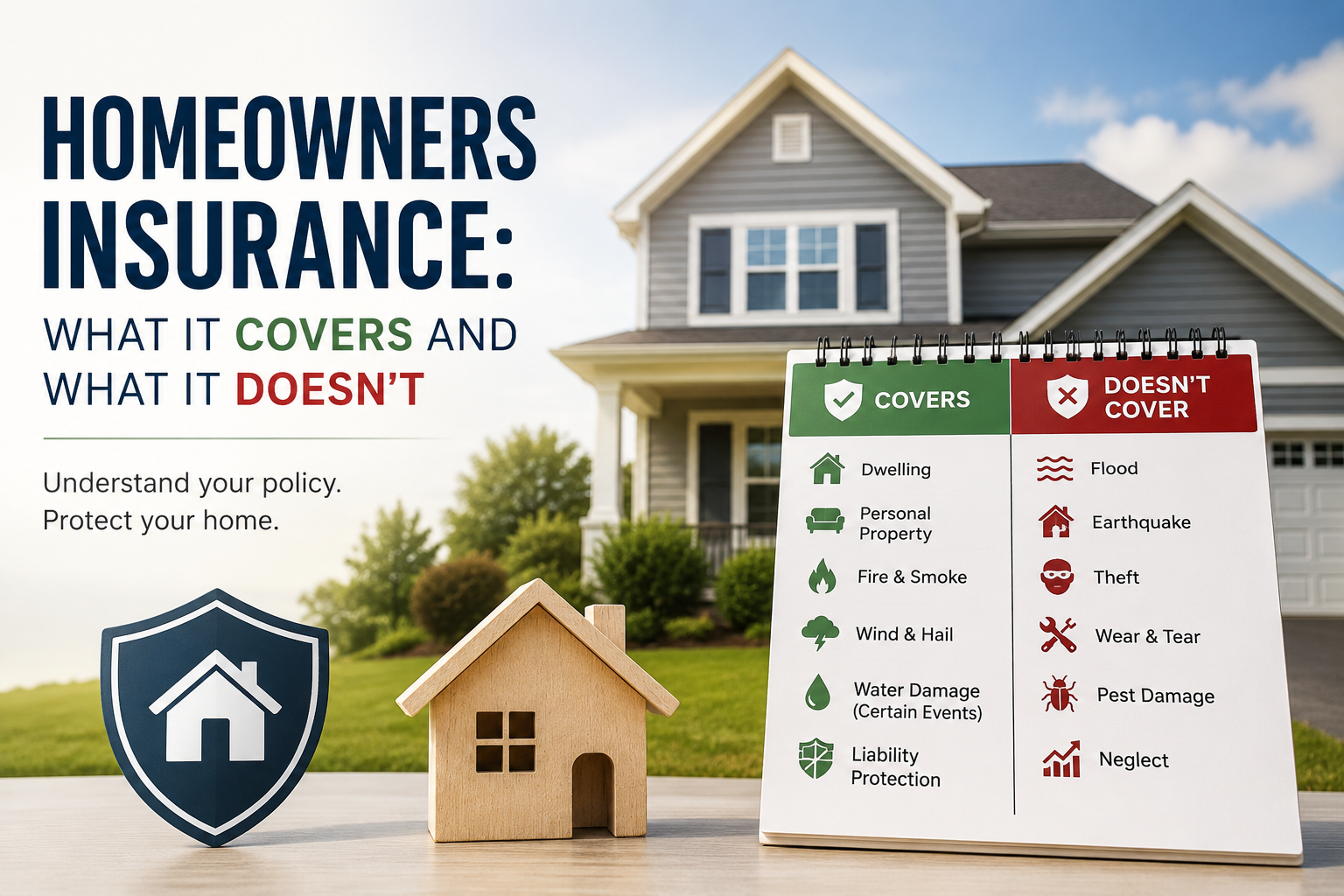
Your home’s structure is protected against a wide range of sudden and accidental events. Under a standard HO-3 policy, the dwelling is covered unless a peril is specifically excluded. Common covered events include:
- Fire and smoke damage
- Lightning strikes
- Windstorms and hail
- Theft and vandalism
- Explosions
- Falling objects (like a tree limb crashing through your roof)
- Weight of ice, snow, or sleet
- Sudden water damage from burst pipes
- Damage from aircraft or vehicles
If a covered event causes structural damage — say a kitchen fire burns through your cabinets and floor joists — your dwelling coverage pays for repairs up to your policy limit.
Personal Property
Your belongings are also protected, though usually under named perils coverage rather than open perils. This means your insurer will only pay for damaged or stolen items if the cause is on the approved list.
High-value items like jewelry, art, collectibles, silverware, and electronics often have sub-limits within a standard policy. If you own expensive pieces, a scheduled personal property endorsement can raise those limits significantly.
Loss of Use / Additional Living Expenses (ALE)
If a covered event makes your home uninhabitable — a fire, a collapsed roof from ice damage — your policy typically pays for the cost of temporary housing, restaurant meals, and other necessary expenses while repairs are underway. This coverage runs until your home is livable again or your limit is exhausted.
Liability Protection
One of the most underappreciated parts of any homeowners policy is personal liability coverage. If a guest slips on your icy steps and sues you, or your dog bites a neighbor, or your child accidentally damages someone else’s property, your liability coverage steps in to pay legal defense costs and any settlements — up to your coverage limit.
Many financial advisors suggest carrying at least $300,000 in liability coverage, and purchasing an umbrella policy for additional protection beyond that.
Medical Payments to Others
Separate from liability, medical payments coverage (Coverage F) pays for minor medical expenses when a guest is injured on your property — regardless of who’s at fault. It’s a goodwill coverage meant to handle small claims without litigation.
What Homeowners Insurance Does NOT Cover
This is where most homeowners get blindsided. Standard policies contain specific exclusions — perils that are clearly left out of coverage. Knowing them in advance lets you fill the gaps.
Flood Damage
Standard homeowners insurance does not cover flooding from any external water source — overflowing rivers, storm surges, heavy rainfall, or water seeping up from the ground. According to FEMA, roughly 25% of all flood claims come from properties outside high-risk flood zones, meaning the risk is broader than most people assume.
If you want flood protection, you’ll need a separate policy — either through the National Flood Insurance Program (NFIP) or a private flood insurer.
Earthquake and Earth Movement
Earthquakes, landslides, sinkholes, and soil settling are excluded from standard policies. If you live in an area prone to seismic activity, you’ll need a standalone earthquake policy or endorsement. In some states — like Florida — insurers are required to offer sinkhole coverage, but it comes as a separate add-on with its own deductible.
Normal Wear and Tear
Insurance is designed to cover sudden, unexpected events — not gradual deterioration. Aging shingles, a slowly rusting water heater, or a foundation that has settled over decades won’t be covered. You’re responsible for ongoing maintenance. Neglect a known problem for long enough, and an insurer can deny a related claim entirely.
Mold
Mold is a complex exclusion. If mold develops as a direct result of a covered peril — say a burst pipe soaks your walls — the resulting mold remediation may be covered. But if mold grows from a slow, unaddressed leak or chronic humidity, it’s typically excluded as a maintenance issue.
Pest Damage
Termites, rodents, bed bugs, and other pests are excluded from homeowners insurance coverage, period. Insurers view infestation as a preventable problem, not a sudden one. Pest control and resulting structural repairs are the homeowner’s responsibility.
Sewer Backup
Standard policies don’t cover damage from sewer lines or drains backing up into your home — even though this is a relatively common and costly problem. Many insurers offer a water backup endorsement for a modest additional premium. It’s worth adding.
Home Business Liability and Equipment
If you run a business from home, your standard homeowners policy offers very limited protection for business equipment or liability connected to business activity. A home business policy or endorsement is the right solution here.
Intentional Damage
Any damage you cause on purpose is excluded. Attempting to file a claim for deliberate damage is considered insurance fraud and carries serious legal consequences.
Common Exclusions at a Glance
| Peril | Covered? | Solution |
|---|---|---|
| Flood | ❌ No | NFIP or private flood policy |
| Earthquake | ❌ No | Separate earthquake policy |
| Sewer backup | ❌ No | Water backup endorsement |
| Wear and tear | ❌ No | Routine home maintenance |
| Mold (non-peril related) | ❌ No | Mold endorsement (some insurers) |
| Pest damage | ❌ No | Pest control plan |
| Home business liability | ❌ Limited | Home business endorsement |
| Intentional damage | ❌ No | N/A |
How to Fill the Gaps in Your Coverage
Knowing what your policy doesn’t cover is only useful if you act on it. Here are practical steps:
- Review your declarations page — This is the summary of your policy limits and coverages. Read it carefully at least once a year.
- Add a sewer backup endorsement — Relatively inexpensive and covers a surprisingly common problem.
- Schedule high-value items — Jewelry, art, instruments, or collectibles worth more than your policy’s sub-limits should be individually scheduled.
- Buy flood insurance separately — Even if you’re not in a designated flood zone, consider it. Flooding is the most common and costly natural disaster in the U.S.
- Consider an umbrella policy — For $200–$400 per year, you can add $1 million or more in liability coverage above your homeowners and auto policies.
- Document your belongings — Keep a home inventory with photos and receipts. Store a copy in the cloud. It makes claims faster and ensures you’re reimbursed accurately.
Replacement Cost vs. Actual Cash Value: A Key Decision
When insuring your personal property, you’ll typically choose between two settlement types:
- Actual Cash Value (ACV): Pays what your item is worth today, factoring in depreciation. A 5-year-old TV gets paid out at its used value, not what a new one costs.
- Replacement Cost Value (RCV): Pays what it costs to buy a comparable new item today. More expensive, but far more useful after a significant loss.
For dwelling coverage specifically, make sure your home is insured for its full replacement cost — what it would cost to rebuild, not what you paid for it or what it’s worth on the market.
Frequently Asked Questions
Does homeowners insurance cover roof damage?
Yes, if the damage is caused by a covered peril like wind, hail, or a falling tree. Gradual deterioration or age-related wear is not covered.
Is my car covered under homeowners insurance if stolen from my driveway?
No. Vehicles are covered under auto insurance, not homeowners. However, personal items stolen from inside the car may be covered under your homeowners policy’s personal property section.
Does homeowners insurance cover water damage from a burst pipe?
Generally yes, if the pipe burst suddenly and unexpectedly. Slow leaks or maintenance-related issues are typically excluded.
Will homeowners insurance pay for a hotel if my house is damaged?
Yes. Loss of use coverage (Coverage D) pays for temporary housing and additional living expenses while your home is being repaired after a covered event.
Does homeowners insurance cover theft outside the home?
Yes. Most standard policies cover personal property theft even when the items are away from your home, though sub-limits may apply.
Is earthquake damage covered?
No. Standard policies exclude earth movement entirely. You need a separate earthquake policy or endorsement.
How much homeowners insurance do I need?
At a minimum, insure your home for its full replacement cost — the cost to rebuild it from scratch. For liability, most experts recommend at least $300,000, plus an umbrella policy if your assets exceed that amount.
Conclusion
Homeowners insurance is not a one-size-fits-all product, and the fine print matters more than most people realize. A standard HO-3 policy gives you solid protection against fire, theft, wind, and liability — but it leaves clear gaps around flooding, earthquakes, sewer backups, and maintenance-related damage.
The smartest thing you can do is read your declarations page today, understand your exclusions, and fill the gaps with endorsements or separate policies before you need them. A claim is not the right time to learn what your policy doesn’t cover.
About the Author