If you’re a business owner trying to figure out which insurance policy you actually need, you’re not alone. Professional liability and general liability insurance are two of the most commonly confused types of business coverage — and choosing the wrong one (or skipping one entirely) can leave your business dangerously exposed.
This guide breaks down both policies clearly, explains who needs what, and helps you decide if carrying both makes sense for your situation.
What Is General Liability Insurance?
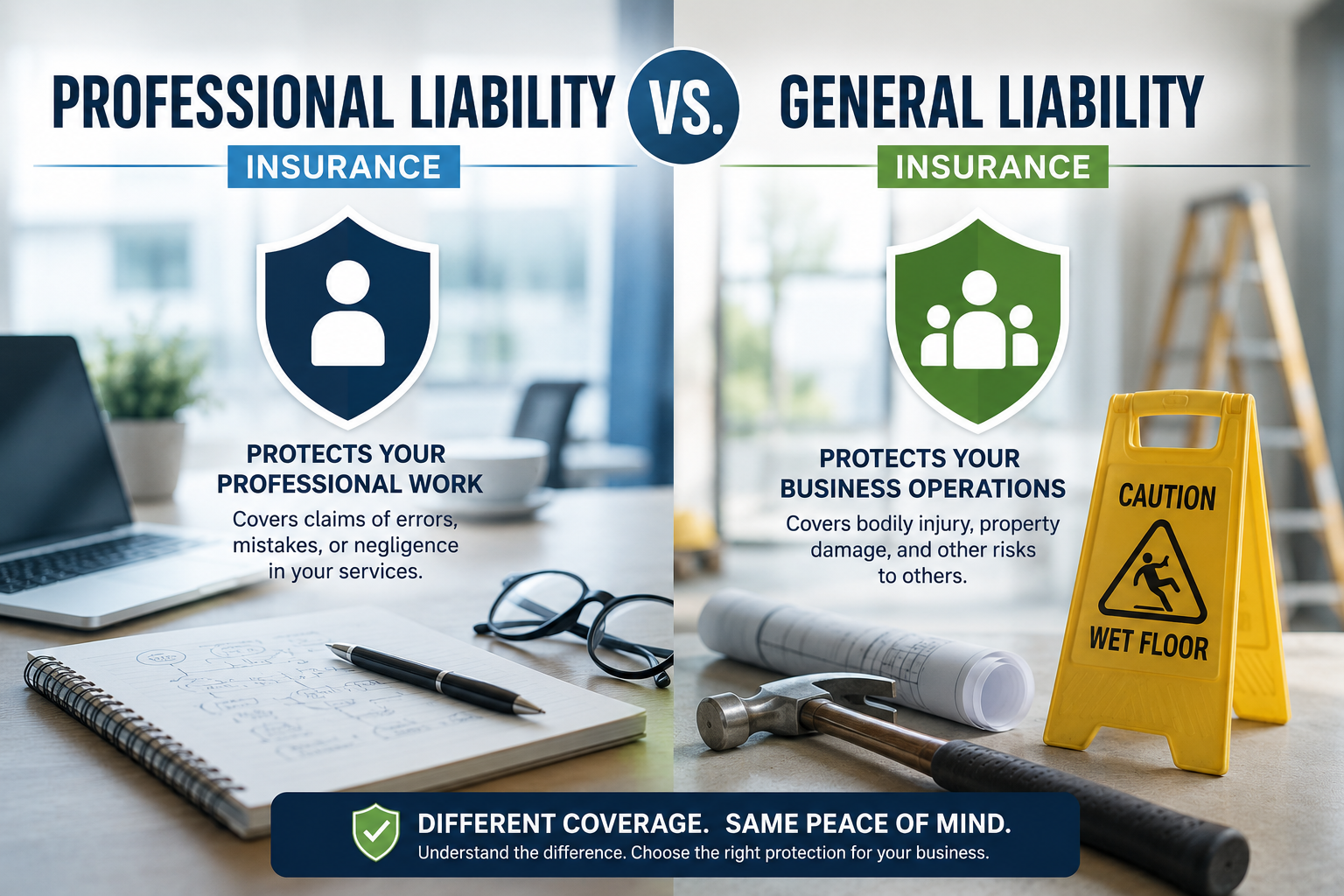
General liability insurance — sometimes called Commercial General Liability (CGL) — is the foundation of most business insurance plans. It protects your business from third-party claims involving physical harm or property damage that arise from everyday operations.
In simpler terms: if someone gets hurt at your place of business, or your employee accidentally damages a client’s property, general liability steps in to cover the costs.
What General Liability Insurance Covers
- Bodily injury – A customer slips and falls on your premises; this policy covers their medical bills and any related legal costs.
- Property damage – Your team accidentally damages a client’s equipment or property during a job.
- Personal and advertising injury – Claims involving slander, libel, or copyright infringement in your marketing materials.
- Legal defense costs – Attorney fees, court costs, and settlements resulting from covered claims.
Almost every business — from a local bakery to a freelance photographer — can benefit from general liability coverage. Many landlords and clients require proof of this policy before signing contracts.
What Is Professional Liability Insurance?
Professional liability insurance — also known as Errors and Omissions (E&O) insurance or malpractice insurance — protects you when a client claims your professional services, advice, or expertise caused them financial harm.
This coverage is specifically designed for service-based professionals. Even if you did nothing wrong, defending yourself against a claim can cost tens of thousands of dollars. Professional liability covers those costs.
What Professional Liability Insurance Covers
- Negligence claims – A client alleges your advice or service caused them a financial loss.
- Errors and omissions – Mistakes or oversights in the work you delivered.
- Misrepresentation – Unintentional inaccurate statements made during professional services.
- Failed deliverables – A client claims you didn’t deliver what was promised.
- Legal defense costs – Even for groundless claims, this policy covers your defense expenses.
Real-world examples:
- An accountant files a client’s tax return incorrectly, resulting in penalties.
- A web developer’s coding error causes an e-commerce site to miss thousands in sales.
- A consultant gives strategic advice that leads to financial losses.
- A financial advisor recommends an investment that tanks a client’s portfolio.
Professional Liability vs. General Liability: Side-by-Side Comparison
| Feature | General Liability | Professional Liability |
|---|---|---|
| Also Known As | CGL, Commercial Liability | E&O Insurance, Malpractice Insurance |
| Type of Risk Covered | Physical / accidental harm | Professional errors, negligence |
| Damage Type | Bodily injury, property damage | Financial/economic loss |
| Claim Trigger | Accidents, physical incidents | Mistakes in services or advice |
| Who Typically Needs It | Almost all businesses | Service-based professionals |
| Coverage Includes | Medical bills, property repair, legal fees | Legal defense, settlements, judgments |
| Examples of Claims | Slip-and-fall, damaged client property | Bad advice, incomplete work, omissions |
| Average Monthly Cost | ~$55/month (median) | ~$50/month (median) |
Key Differences Between the Two Policies
Understanding the core distinctions helps you make a smarter coverage decision.
1. The Type of Harm They Address
General liability covers physical and tangible harm — a broken bone, a cracked laptop, a damaged floor. Professional liability covers economic and reputational harm — a botched financial plan, an inaccurate report, or advice that led to a bad business decision.
2. How the Claims Arise
General liability claims stem from accidents and unexpected events. Professional liability claims arise from how your work was performed — the quality, accuracy, and judgment behind your services.
3. Who Files the Claim
In both cases, a third party files the claim. But with general liability, it’s typically a visitor, vendor, or bystander. With professional liability, it’s almost always a client who hired you for a specific service.
4. Policy Structure
Professional liability is often written on a claims-made basis, meaning coverage applies only if both the incident and the claim occur while the policy is active. General liability is often written on an occurrence basis, covering incidents that happen during the policy period regardless of when the claim is filed.
Who Needs General Liability Insurance?
Virtually every business that interacts with customers, rents a commercial space, or handles client property should carry general liability coverage. Specifically, you likely need it if:
- You have a physical location open to clients or the public
- Your employees visit customer sites
- You handle or work near client property
- A landlord or client contract requires proof of insurance
- You sell physical products
Who Needs Professional Liability Insurance?
Professional liability is essential for anyone who provides advice, specialized knowledge, or professional services for a fee. You likely need it if:
- You work in consulting, IT, law, accounting, or finance
- You provide medical, therapeutic, or healthcare services
- You design deliverables like software, marketing campaigns, or architectural plans
- Clients rely on your expertise for financial or operational decisions
- Your state legally requires it for your profession
Do You Need Both?
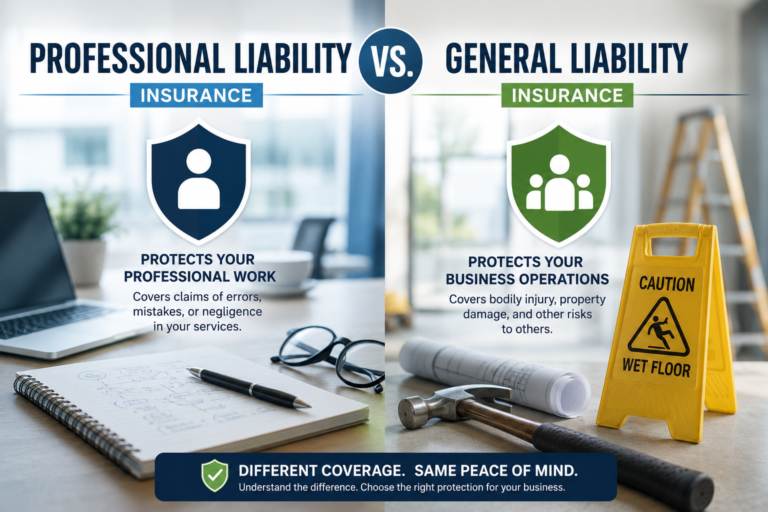
For many businesses, the honest answer is yes. The two policies are not interchangeable — they protect against entirely different risks. Carrying only one can leave a serious coverage gap.
Businesses that typically need both include:
- IT companies and software developers
- Architecture and engineering firms
- Medical practices and healthcare providers
- Financial advisors and accountants
- Real estate agents and insurance brokers
- Fitness studios and personal trainers
- Contractors who also provide design or consulting services
Consider this scenario: you’re a marketing consultant. A client visits your office, trips over a cable, and breaks their wrist — that’s a general liability claim. That same client later sues you because your ad campaign underperformed — that’s a professional liability claim. Without both policies, one of those situations leaves you unprotected.
How Much Does Each Policy Cost?
Costs vary based on industry, business size, claims history, and coverage limits, but here’s a general benchmark:
| Policy | Median Monthly Cost | Typical Annual Range |
|---|---|---|
| General Liability | ~$55/month | $300 – $1,200/year |
| Professional Liability | ~$50/month | $500 – $5,000+/year |
Higher-risk industries like healthcare, legal services, and construction will sit at the upper end of those ranges. Sole proprietors in low-risk fields often pay less.
What These Policies Don’t Cover
It’s just as important to know the limitations:
- General liability does not cover employee injuries (that’s workers’ compensation), professional mistakes, or intentional acts.
- Professional liability does not cover bodily injuries, physical property damage, or employee-related claims.
- Neither policy covers commercial auto accidents, cyber breaches, or criminal acts.
How to Choose the Right Coverage
Ask yourself these four questions:
- Do people visit my business location? → You likely need general liability.
- Do I provide advice, services, or expertise for a fee? → You likely need professional liability.
- Could a mistake on my part cost a client money? → Professional liability is essential.
- Does my lease or client contract require proof of insurance? → General liability is almost certainly required.
If you answered yes to questions in both groups, carry both policies. The combined monthly premium is often well under $150, which is a small price compared to the cost of an uninsured lawsuit.
Conclusion
Professional liability and general liability insurance serve different — but equally important — purposes. General liability shields your business from the physical accidents of everyday operations, while professional liability protects your reputation and finances when a client challenges the quality of your work.
Most service-based businesses benefit from carrying both. The good news is that bundling both policies with the same insurer is usually straightforward and can reduce your overall premium. Talk to a licensed insurance broker to evaluate your specific risk exposure and build a coverage plan that fits your business.
Frequently Asked Questions (FAQs)
Is professional liability the same as E&O insurance?
Yes. Professional liability insurance is commonly referred to as Errors and Omissions (E&O) insurance — the terms are used interchangeably across most industries.
Can general liability cover a professional mistake?
No. General liability only covers physical injuries and property damage, not financial losses caused by professional errors or negligent advice.
Is professional liability insurance tax deductible?
In most cases, yes. Business insurance premiums — including professional liability — are generally considered ordinary business expenses and are tax deductible. Consult a tax professional for your specific situation.
Which policy is more expensive?
Costs are similar at the median level, but professional liability can run significantly higher in high-risk fields like medicine, law, or financial advising due to complex claim evaluations and larger settlements.
Do freelancers need professional liability insurance?
Yes, especially if you provide consulting, design, writing, IT, or any service where a client relies on your expertise. Even a single disputed project can lead to a costly lawsuit.
What is the difference between occurrence and claims-made policies?
An occurrence policy covers incidents that happen during the policy period, regardless of when the claim is filed. A claims-made policy only covers claims filed while the policy is active — common in professional liability coverage.
Can I bundle both policies together?
Yes. Many insurers offer a Business Owner’s Policy (BOP), which often combines general liability with property insurance. You can typically add professional liability as an endorsement or as a separate policy with the same provider.
About the Author