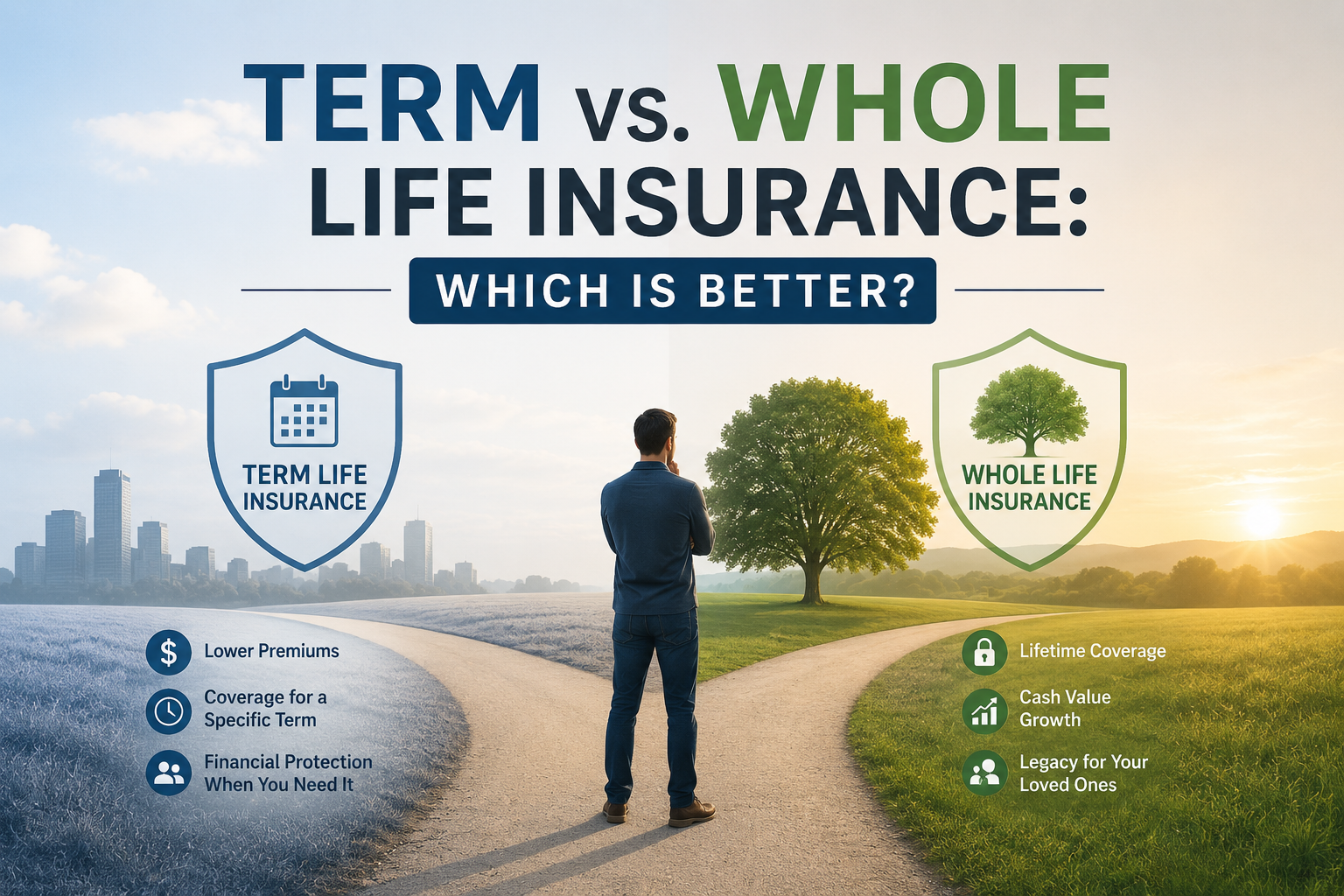
Life insurance is one of the most important financial decisions you’ll ever make — yet most people aren’t sure whether to choose term or whole life. Both policies pay a death benefit to your loved ones, but they work very differently when it comes to cost, coverage length, and long-term value.
This guide breaks down the key differences between term and whole life insurance, compares costs side by side, and helps you figure out which policy actually fits your life.
What Is Term Life Insurance?
Term life insurance provides coverage for a fixed period — typically 10, 20, or 30 years. If you pass away during that term, your beneficiaries receive the death benefit. If you outlive the policy, coverage simply ends with no payout.
Key features of term life insurance:
- Coverage lasts for a set number of years (10–30)
- Premiums remain level and locked in for the entire term
- No cash value or investment component
- Significantly lower monthly premiums than whole life
- Death benefit is paid out tax-free to beneficiaries
Term life is often described as “pure” life insurance — you’re paying strictly for financial protection, nothing more.
What Is Whole Life Insurance?
Whole life insurance is a type of permanent life insurance that covers you for your entire lifetime, as long as you keep paying premiums. In addition to the death benefit, it includes a cash value component that grows at a guaranteed rate over time.
Key features of whole life insurance:
- Coverage lasts your entire life — no expiration
- Builds cash value you can borrow against or withdraw
- Premiums are fixed and never increase with age
- May earn dividends depending on the insurer
- Death benefit is guaranteed regardless of when you pass
Think of whole life as a hybrid: part life insurance, part savings vehicle.
Term vs. Whole Life Insurance: Side-by-Side Comparison
| Feature | Term Life Insurance | Whole Life Insurance |
|---|---|---|
| Coverage Length | 10–30 years | Lifetime |
| Monthly Premiums | Low | High (5–15x more) |
| Cash Value | None | Yes, grows tax-deferred |
| Death Benefit | Paid if you die during term | Guaranteed payout |
| Premium Stability | Fixed for term length | Fixed for life |
| Policy Expiration | Yes, at end of term | No |
| Borrowing Against Policy | Not available | Available |
| Best For | Income replacement, mortgage protection | Estate planning, lifelong dependents |
Cost Comparison: How Much Does Each Policy Cost?
Cost is one of the biggest differences between these two policy types. For a healthy, non-smoking 35-year-old seeking $500,000 in coverage, here’s a rough breakdown of average monthly premiums:
| Policy Type | Coverage | Estimated Monthly Premium |
|---|---|---|
| 20-Year Term (Male) | $500,000 | ~$28–$35 |
| 20-Year Term (Female) | $500,000 | ~$22–$28 |
| Whole Life (Male) | $500,000 | ~$350–$500 |
| Whole Life (Female) | $500,000 | ~$300–$430 |
Rates are estimates for illustrative purposes. Actual premiums vary by insurer, health class, state, and underwriting.
The difference is dramatic. Whole life premiums can run 8 to 15 times higher than term for the same death benefit amount. That said, whole life locks in your rate permanently — no re-qualification needed as you age or if your health declines.
Pros and Cons of Term Life Insurance
Pros
- Affordable premiums — you can get substantial coverage without breaking your budget
- Simple to understand — no investment complexity
- Flexible coverage periods — match the term to your financial obligations (e.g., until your mortgage is paid or your kids are grown)
- Convertible options — many policies let you convert to permanent life insurance before the term ends
Cons
- No cash value — premiums don’t build equity
- Coverage expires — if you still need insurance after the term, you’ll pay higher rates or may be uninsurable due to health changes
- No payout if you outlive the term — statistically, the majority of term policies expire without a claim
Pros and Cons of Whole Life Insurance
Pros
- Lifetime protection — your family is covered no matter when you pass
- Cash value growth — functions as a tax-deferred savings component you can access during your lifetime
- Fixed premiums — rates never increase, giving you long-term predictability
- Estate planning tool — useful for leaving an inheritance or covering estate taxes
- Potential dividends — some mutual insurers pay annual dividends on whole life policies
Cons
- High premiums — significantly more expensive than term coverage
- Slow cash value growth — it often takes years before the policy builds meaningful value
- Complexity — harder to compare policies across insurers
- Opportunity cost — money tied up in premiums could potentially earn more in other investments
“Buy Term and Invest the Difference” — Does It Work?
A popular financial strategy suggests buying a cheap term policy and investing the premium savings in index funds or retirement accounts instead of paying for expensive whole life insurance.
The logic: because term coverage is so much cheaper, you can secure a large death benefit when your family needs it most — during your working years — while building wealth through other vehicles like a 401(k) or Roth IRA.
This approach works well if you actually invest the difference and maintain discipline over time. For most middle-income earners with straightforward financial needs, it’s a sound strategy.
However, it’s not a universal solution. High-net-worth individuals, business owners, and those with complex estate plans often benefit from the permanent nature and tax advantages of whole life insurance.
Which Is Better for You? A Practical Guide
There’s no universal winner — the right policy depends on your personal situation. Here’s how to think through it:
Choose Term Life Insurance If:
- You need affordable coverage to protect your family’s income
- You have a mortgage, student loans, or other debt you want covered
- Your kids are young and financially dependent
- You’ve already maxed out tax-advantaged retirement accounts
- Budget is your primary concern
Choose Whole Life Insurance If:
- You need coverage that will never expire
- You have a lifelong dependent, such as a child with special needs
- You’re using life insurance as part of an estate plan
- You want a guaranteed death benefit regardless of age
- You’re a high-income earner looking for additional tax-deferred savings
Can You Switch from Term to Whole Life?
Yes — many term policies include a conversion rider that allows you to convert to a permanent policy without a new medical exam. If you’re considering the switch, timing matters. Converting while you’re younger and healthier means lower whole life premiums. If your term is nearing its end, it may make sense to plan the transition so there’s no gap in coverage.
Frequently Asked Questions
Is term or whole life insurance better for most people?
For most families, term life insurance is the better choice because it provides maximum coverage at the lowest cost during the years you need it most.
Does term life insurance build cash value?
No. Term life insurance does not accumulate any cash value. Premiums are paid purely for the death benefit coverage.
Can I have both term and whole life insurance?
Yes. Some people carry a term policy for income replacement during their working years and a smaller whole life policy for permanent, final expense coverage.
What happens when a term life policy expires?
Coverage ends with no payout. You may have the option to renew at a higher premium, convert to a permanent policy, or purchase a new policy.
Is whole life insurance a good investment?
It depends on your goals. Whole life is not designed to compete with market investments. Its appeal lies in guaranteed, tax-deferred growth and lifelong coverage — not maximum returns.
At what age should I buy life insurance?
The earlier the better. Younger, healthier applicants qualify for the lowest premiums on both term and whole life policies.
What is the cash value in whole life insurance?
Cash value is a savings component built into whole life policies. It grows at a guaranteed rate over time and can be borrowed against, withdrawn, or used to pay premiums.
Conclusion
Term life insurance offers straightforward, affordable protection for a set period — ideal for most working adults who want to protect their family’s financial future without overpaying. Whole life insurance offers permanent coverage, cash value accumulation, and estate planning advantages — but comes at a significantly higher cost.
For the majority of people, term life is the smarter starting point. But if your financial picture includes lifelong dependents, complex estate needs, or you’ve already maxed out other savings vehicles, whole life insurance may be worth the investment.
The best move? Get clear on your financial goals, compare quotes from multiple insurers, and if possible, speak with an independent financial advisor who can assess your specific situation without bias toward either product.
About the Author