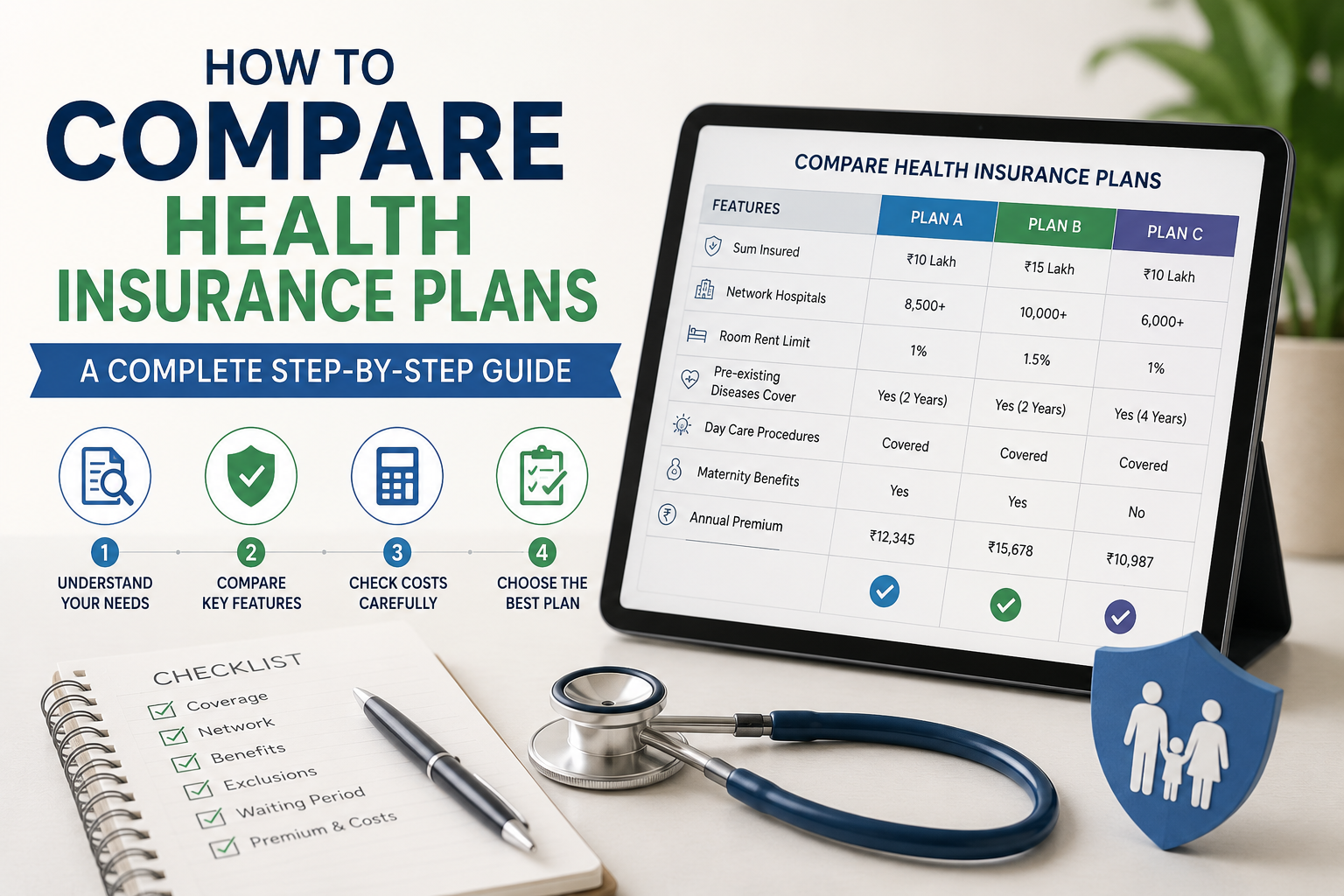
Choosing the wrong health insurance plan can cost you thousands of dollars — and leave you without coverage when you need it most. Whether you’re shopping on the marketplace, switching employer plans, or exploring options for the first time, knowing how to compare health insurance plans the right way makes all the difference.
This guide breaks down everything you need to evaluate: plan types, costs, networks, drug coverage, and common mistakes to avoid — so you can make a confident, informed decision.
Why Comparing Health Insurance Plans Matters
Most people pick a plan based on the monthly premium alone. That’s a costly mistake. A plan with a low premium can easily cost you more overall if it comes with a sky-high deductible, limited network, or poor prescription drug coverage.
The goal isn’t to find the cheapest plan — it’s to find the best-value plan for your specific health needs and budget.
Step 1: Understand the Main Types of Health Insurance Plans
Before comparing specific plans, you need to know what type of plan you’re looking at. Each plan type works differently in terms of flexibility, cost, and how you access care.
| Plan Type | Requires PCP? | Out-of-Network Coverage? | Referrals Needed? | Best For |
|---|---|---|---|---|
| HMO | Yes | No (emergency only) | Yes | Budget-conscious, predictable care needs |
| PPO | No | Yes (at higher cost) | No | Those who want flexibility |
| EPO | No | No | No (usually) | Moderate budget, no need for PCP |
| POS | Yes | Yes (at higher cost) | Yes | Balance of cost and flexibility |
| HDHP | No | Varies | No | Healthy individuals; HSA-eligible |
HMO (Health Maintenance Organization)
HMO plans typically offer the lowest premiums and require you to stay within a defined provider network. You’ll need a primary care physician (PCP) who coordinates your care and provides referrals to specialists. These work well if your doctors are already in-network and you prefer lower, more predictable costs.
PPO (Preferred Provider Organization)
PPO plans are the most flexible. You can see any doctor — in or out of network — without a referral. That freedom comes with higher monthly premiums. If you travel frequently, see specialists regularly, or simply value choice, a PPO may be worth the extra cost.
HDHP (High-Deductible Health Plan)
HDHPs pair low monthly premiums with a high deductible — at least $1,650 for an individual in 2025. The big advantage: you can open a Health Savings Account (HSA) and set aside pre-tax dollars for medical expenses. These plans are ideal for generally healthy people who don’t expect frequent care.
EPO (Exclusive Provider Organization)
EPOs sit between HMOs and PPOs. They cover only in-network care (like HMOs) but don’t require referrals or a PCP (like PPOs). Premiums are lower than PPOs but higher than HMOs.
Step 2: Know the Five Key Cost Components
Every health insurance plan is defined by five financial numbers. Understanding all five — not just the premium — is essential to an accurate cost comparison.
1. Monthly Premium
This is what you pay every month to keep coverage active, regardless of whether you use any healthcare. Think of it as a subscription fee. Lower premiums usually mean higher out-of-pocket costs when you actually need care.
2. Annual Deductible
The amount you pay out of pocket before your insurance starts sharing costs. A $2,000 deductible means you cover the first $2,000 of covered services yourself. Plans with higher deductibles typically have lower premiums.
3. Copay
A fixed dollar amount you pay for a specific service — for example, $30 for a primary care visit or $15 for a generic prescription. Copays on many plans apply even before you’ve met your deductible.
4. Coinsurance
After meeting your deductible, you split remaining costs with your insurer. If your coinsurance is 20%, you pay 20% and the insurer pays 80% of covered services. This continues until you hit the out-of-pocket maximum.
5. Out-of-Pocket Maximum (MOOP)
This is the most you’ll pay in a single year for covered services. Once you reach this ceiling, the insurer covers 100% of covered costs for the rest of the year. It’s your financial safety net for worst-case scenarios.
Pro tip: Add up your estimated annual premium plus your likely out-of-pocket spending based on your typical healthcare use. This total cost comparison often reveals that a “cheaper” plan is actually more expensive.
Step 3: Check the Provider Network
Before you fall in love with a plan’s price, verify that your doctors are actually in-network.
- Look up your primary care doctor in the plan’s provider directory
- Check any specialists you see regularly (cardiologist, dermatologist, etc.)
- Confirm your preferred hospital or urgent care center is included
- If a provider is out-of-network, expect significantly higher costs — or no coverage at all, depending on the plan type
Insurers update their networks every year. Even if your doctor was in-network last year, that can change. Always verify before you re-enroll.
Step 4: Review Prescription Drug Coverage
If you take regular medications, prescription coverage can make or break a plan’s value.
Every plan has a drug formulary — a tiered list of covered medications. Here’s how tiers typically work:
| Tier | Drug Type | Typical Copay |
|---|---|---|
| Tier 1 | Generic drugs | $5–$15 |
| Tier 2 | Preferred brand-name | $25–$50 |
| Tier 3 | Non-preferred brand-name | $60–$100+ |
| Tier 4 | Specialty drugs | 25–33% coinsurance |
A medication that costs $10 on one plan could cost $75 on another — a difference that adds up to hundreds of dollars annually. Always check the formulary for any medications you take regularly before selecting a plan.
Step 5: Consider Your Health Needs and Usage Pattern
Be honest with yourself about how much healthcare you actually use. Most people fall into one of three usage categories:
- Low users: Generally healthy, rarely see a doctor, no regular prescriptions → Consider an HDHP with an HSA
- Moderate users: A few doctor visits per year, one or two prescriptions → A mid-tier PPO or EPO often works well
- High users: Chronic conditions, regular specialist visits, multiple medications → A plan with a lower deductible and richer benefits is usually worth the higher premium
Model your expected medical expenses under each plan you’re considering. Which plan produces the lowest total annual cost at your typical usage level? That’s usually your best choice.
Step 6: Look for Additional Benefits
Many plans now offer extras beyond basic medical coverage. When comparing options, look for:
- Telehealth services — virtual visits at low or no cost
- Mental health coverage — therapy sessions, psychiatry access
- Preventive care — many ACA-compliant plans cover preventive services at $0 before the deductible
- Dental and vision — especially important if comparing marketplace or employer plans
- HSA compatibility — only HDHPs qualify; an HSA lets you save pre-tax dollars for medical costs
Step 7: Check If You Qualify for Subsidies
If you’re buying a plan through the Health Insurance Marketplace (healthcare.gov), check whether you qualify for a premium tax credit or cost-sharing reductions. Eligibility is based on your household income and size.
- Subsidies are available for incomes between 100% and 400% of the federal poverty level (and beyond, under expanded ACA rules)
- Cost-sharing reductions on Silver plans can significantly lower your deductible and copays
- Even if you’re self-employed, you may qualify — always check before purchasing off-marketplace
Common Mistakes to Avoid When Comparing Plans
- Choosing the lowest premium without calculating total cost — A plan with a $200 monthly premium and $6,000 deductible can easily cost more than a $350 plan with a $1,000 deductible if you use moderate care.
- Ignoring network changes at renewal — Verify your providers are still in-network every year before re-enrolling.
- Overlooking formulary changes — A drug that was Tier 2 last year may move to Tier 3 this year, doubling your copay.
- Skipping the out-of-pocket maximum — For people with serious health conditions, a plan with a lower out-of-pocket max can be far more valuable than its premium suggests.
- Not accounting for telehealth — Some plans offer robust virtual care benefits that reduce your need for expensive in-person visits.
Quick Comparison Checklist
Use this checklist when evaluating any health insurance plan side by side:
- [ ] Monthly premium amount
- [ ] Annual deductible (individual and family)
- [ ] Copays for primary care, specialist, and urgent care visits
- [ ] Coinsurance percentage
- [ ] Out-of-pocket maximum
- [ ] Network type (HMO, PPO, EPO, POS, HDHP)
- [ ] In-network status of your doctors and hospitals
- [ ] Prescription drug formulary tiers and your medication costs
- [ ] Mental health and telehealth benefits
- [ ] HSA eligibility
- [ ] Subsidy eligibility (if buying on marketplace)
Conclusion
Comparing health insurance plans doesn’t have to be overwhelming. Start by understanding the plan type, then dig into the five core cost components, verify your provider network, and check your drug coverage. Finally, run the numbers based on how much healthcare you actually use — not just the sticker price of the premium.
The right plan balances what you pay every month with what you’ll pay when you actually need care. Take the time to compare thoroughly, and you’ll avoid the costly surprises that catch too many people off guard.
Frequently Asked Questions (FAQs)
What is the most important factor when comparing health insurance plans?
Total annual cost — premium plus expected out-of-pocket spending — is the most important factor, not just the monthly premium.
What’s the difference between a deductible and an out-of-pocket maximum?
The deductible is what you pay before insurance kicks in; the out-of-pocket maximum is the most you’ll pay in a year, after which the insurer covers 100%.
How do I know if my doctor is in-network?
Use the insurer’s online provider directory or call your doctor’s office directly to confirm they accept the specific plan you’re considering.
Is an HMO or PPO better?
It depends on your needs. HMOs are cheaper but restrictive; PPOs offer more flexibility at a higher cost. If you need specialist access or travel often, a PPO is usually better.
Can I switch health insurance plans anytime?
Generally, you can only switch during open enrollment or if you experience a qualifying life event (job loss, marriage, birth of a child) that triggers a Special Enrollment Period.
What is an HSA, and which plans qualify?
A Health Savings Account (HSA) lets you save pre-tax money for medical expenses. Only High-Deductible Health Plans (HDHPs) are eligible for an HSA.
Should I choose a plan based on my prescriptions?
Yes. Check the plan’s drug formulary to see which tier your medications fall under — this can significantly affect your total annual cost.
What does “coinsurance” mean on a health insurance plan?
Coinsurance is your percentage share of costs after meeting your deductible. For example, 20% coinsurance means you pay 20% and the insurer pays 80% of covered services.
About the Author