Your insurance needs don’t stay the same — they evolve right along with your life. Whether you’re a fresh graduate stepping into your first job, a new parent protecting your growing family, or a retiree thinking about legacy planning, the right coverage at the right time makes all the difference. Understanding how your insurance requirements shift at each life stage helps you stay protected without overpaying for coverage you don’t need.
Why Insurance Needs Change Throughout Life
Insurance is fundamentally about protecting what matters most to you at any given moment. At 22, that might be your income. At 35, it’s your family and your mortgage. At 65, it’s your health and your estate. Each stage brings new financial responsibilities, new risks, and new priorities.
Financial advisors consistently emphasize that reviewing your insurance coverage after every major life event — marriage, having a child, buying a home, or approaching retirement — is just as important as building a savings account. Failing to update your coverage can leave dangerous gaps in your financial safety net.
Insurance Needs by Life Stage
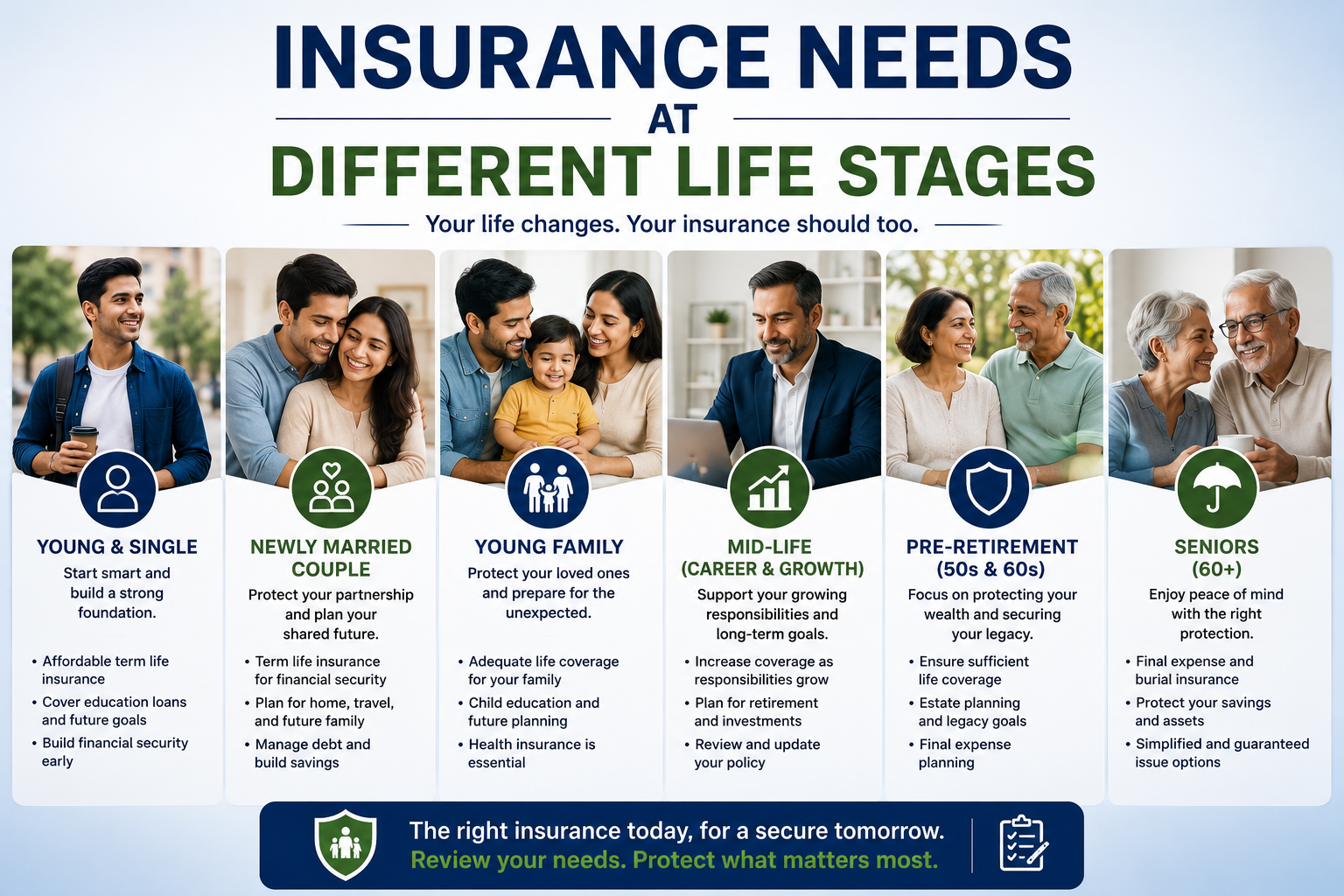
Stage 1: Young Adults (Ages 18–25) — Building the Foundation
Most young adults overlook insurance entirely, assuming it’s something they’ll deal with “later.” That mindset can be costly.
Key insurance priorities at this stage:
- Health Insurance: If you’re off your parents’ plan (typically after age 26), securing individual health coverage is essential. Employer-sponsored plans are often the most affordable entry point.
- Renters Insurance: If you’re renting your first apartment, renters insurance protects your belongings and covers personal liability — typically for as little as $15–$30/month.
- Auto Insurance: Required by law in most places if you own a vehicle.
- Disability Insurance: Often overlooked, but statistically more than 1 in 4 of today’s 20-year-olds will face a disabling condition before retirement age. If your employer offers group disability coverage, enrolling is a smart early move.
Life insurance at this stage? It’s a low priority for most singles without dependents. However, if you have co-signed student loans or private debt, a modest term life policy can prevent leaving that burden to a parent or co-signer.
Quick Tip: Buying life insurance young and healthy locks in lower premiums for the life of the policy.
Stage 2: Newly Married Couples (Ages 25–35) — Shared Responsibilities
Marriage changes your financial picture immediately. Now, someone else’s financial wellbeing depends on your stability — and vice versa.
Key insurance priorities at this stage:
- Life Insurance: Both spouses should carry coverage. Even if one spouse doesn’t work outside the home, the economic value of childcare and household management is significant. Term life insurance is highly cost-effective at this age.
- Health Insurance: Review whether a joint plan or separate employer plans offer better overall coverage and cost.
- Disability Insurance: Income protection is critical when two people are relying on a combined income to pay rent, a mortgage, or shared debts.
- Homeowners Insurance: If you purchase a home together, this is non-negotiable. It protects your property, your belongings, and your liability exposure.
Coverage tip: After getting married, update your beneficiary designations on all existing policies. An outdated beneficiary form can cause serious legal complications later.
Stage 3: Growing Families (Ages 30–45) — Maximum Protection Mode
This is often the most coverage-intensive stage of life. You may have a mortgage, young children, a higher income, and more financial obligations than at any other point.
Key insurance priorities at this stage:
| Insurance Type | Why It Matters |
|---|---|
| Term Life Insurance | Replace lost income and cover mortgage payments if a parent dies |
| Health Insurance | Cover the whole family, including pediatric care and maternity |
| Disability Insurance | Protect income if illness or injury prevents you from working |
| Homeowners/Auto Insurance | Protect your largest physical assets |
| Umbrella Liability Insurance | Extra liability layer as your assets grow |
| Critical Illness Insurance | Covers major diagnoses like cancer or heart disease |
A 30-year-old in good health can secure a $1 million term life policy for well under $500 per year — making this one of the most affordable times to lock in strong coverage.
Don’t overlook:
- Life insurance for the stay-at-home spouse
- Increasing auto insurance liability limits if you add a teen driver
- Reviewing coverage amounts as your income and assets grow
Stage 4: Mid-Life (Ages 45–55) — Protecting Peak Earning Years
Your 40s and 50s often bring peak earnings, but also peak financial exposure. The mortgage isn’t paid off yet, kids may be heading to college, and retirement is getting closer on the horizon.
Key insurance priorities at this stage:
- Life Insurance: Maintain your existing term policy. Consider whether a permanent (whole life or universal life) policy makes sense for estate planning.
- Long-Term Care (LTC) Insurance: The ideal time to buy is your mid-50s, when you’re still healthy enough to qualify at reasonable rates. LTC covers nursing home care, assisted living, and in-home care — costs that Medicare typically does not cover.
- Critical Illness Insurance: Health risks rise in this decade. A lump-sum payout from a critical illness policy helps cover out-of-pocket medical costs without depleting savings.
- Disability Insurance: Keep it active until retirement. The average long-term disability claim lasts nearly 35 months — long enough to devastate household finances without coverage.
Estate planning note: Review your life insurance beneficiaries, especially after any divorces, remarriages, or changes in family structure.
Stage 5: Pre-Retirement (Ages 55–65) — Transitioning Coverage
As you near retirement, your insurance strategy shifts from income protection toward wealth preservation and healthcare planning.
Key insurance priorities at this stage:
- Long-Term Care Insurance: If you haven’t purchased it yet, this is close to your last practical window. Premiums rise sharply with age and declining health.
- Life Insurance: Evaluate whether your term policy still serves your current goals. If your children are financially independent and your mortgage is paid off, your need may be reduced — but a permanent policy can serve legacy planning.
- Health Insurance (pre-Medicare): If you retire before age 65, you need a bridge plan until Medicare eligibility. Options include COBRA, ACA marketplace plans, or a spouse’s employer plan.
- Medicare Supplement (Medigap): Begin researching your options before you turn 65 so you’re ready to enroll on time.
Stage 6: Retirement (Ages 65+) — Security and Legacy
Retirement brings the end of active income — meaning your insurance needs shift significantly once again.
Key insurance priorities at this stage:
- Medicare + Medigap: Original Medicare leaves significant out-of-pocket gaps. A Medigap supplemental policy covers many of those costs and provides financial predictability for healthcare.
- Long-Term Care Insurance: If you haven’t secured it, explore hybrid life/LTC policies that combine a death benefit with care coverage.
- Life Insurance for Legacy: Even with reduced income needs, permanent life insurance can help cover estate taxes, funeral costs, and ensure dependents receive a planned inheritance.
- Homeowners/Auto: Maintain these but reassess coverage amounts as the value of your assets changes.
Important: Disability insurance typically expires at age 65. If you haven’t already transitioned to long-term care coverage, do so promptly — your health may make it harder to qualify as time passes.
Insurance Coverage Summary by Life Stage
| Life Stage | Top Priorities |
|---|---|
| Young Adult (18–25) | Health, renters, auto, disability (if employer-offered) |
| Newly Married (25–35) | Term life, health, disability, homeowners |
| Growing Family (30–45) | Term life (both spouses), disability, health, umbrella liability |
| Mid-Life (45–55) | Long-term care, critical illness, disability, life insurance review |
| Pre-Retirement (55–65) | LTC, health bridge, Medigap planning, life insurance review |
| Retirement (65+) | Medicare + Medigap, LTC, legacy life insurance |
How Often Should You Review Your Insurance?
Financial experts recommend reviewing your coverage:
- After every major life event — marriage, divorce, new baby, home purchase, job change
- Every 3–5 years — even without major changes, your needs evolve gradually
- Before renewing a policy — shop for competitive rates and updated coverage options
- As you enter a new life decade — your 30s, 40s, 50s, and 60s each bring distinct coverage priorities
Conclusion
Insurance isn’t a one-size-fits-all solution, and it’s not a purchase you make once and forget. The right coverage evolves as your responsibilities grow, shift, and eventually wind down. Starting early gives you lower premiums and better options. Reviewing regularly keeps you from being over- or under-insured. And thinking ahead — especially about long-term care and retirement health coverage — can protect everything you’ve spent a lifetime building.
Talk to a licensed insurance advisor or financial planner to tailor coverage to your exact situation. The best policy isn’t the cheapest one — it’s the one that actually protects what matters most to you, right now.
Frequently Asked Questions (FAQs)
What type of insurance is most important for young adults?
Health insurance and disability insurance are the top priorities for young adults, as they protect your income and wellbeing during your most financially vulnerable years.
When should I buy life insurance?
The earlier the better — younger, healthier applicants pay significantly lower premiums. Most advisors recommend buying life insurance in your 20s or 30s, especially after you take on financial dependents.
Do I need life insurance if I’m single with no kids?
Generally no, unless you have co-signed debt or financially support a parent. Once you have dependents or a mortgage, life insurance becomes essential.
What is long-term care insurance and when should I buy it?
Long-term care insurance covers costs for nursing homes, assisted living, and in-home care. The best time to purchase it is in your mid-50s, when you’re likely still healthy and premiums are more manageable.
Does my insurance need change after retirement?
Yes. In retirement, disability insurance is no longer needed, but Medicare, Medigap, and long-term care insurance become the primary focus. Life insurance may still be valuable for legacy planning.
How much life insurance do I actually need?
A common guideline is 10–12 times your annual income, but your actual need depends on your debts, dependents, income, and financial goals. An insurance advisor can help calculate the right amount.
What is umbrella insurance and who needs it?
Umbrella insurance provides extra liability coverage beyond your home and auto policies. It’s especially valuable for families with growing assets, as it protects against large lawsuits or liability claims.
About the Author